Ship Structure and Terminology: LOA, LBP, Beam, Draught and Freeboard | Complete Guide for Cadets and MEO Class 4


Understanding ship dimensions is one of the first things every marine engineer, deck cadet, naval architecture student and seafarer should learn. Terms such as LOA, LBP, LWL, moulded breadth, draught, freeboard, camber, sheer and deadweight appear regularly in ship plans, stability calculations, loading operations, dry-docking and maritime regulations.
These terms may look complicated at first, but once the reference points and basic measurements are understood, ship terminology becomes much easier to remember.
This guide explains the most important ship dimensions and hull terminology in simple language, along with their practical applications.
What Are Ship Dimensions?
Ship dimensions are measurements used to describe the size, shape and carrying characteristics of a vessel.
The principal dimensions of a ship generally include:
Length
Breadth or beam
Depth
Draught
Freeboard
Displacement
Deadweight
Gross tonnage
Net tonnage
These dimensions are important because they influence the ship's stability, buoyancy, cargo capacity, resistance, manoeuvrability, structural strength and operational limitations.
Forward Perpendicular
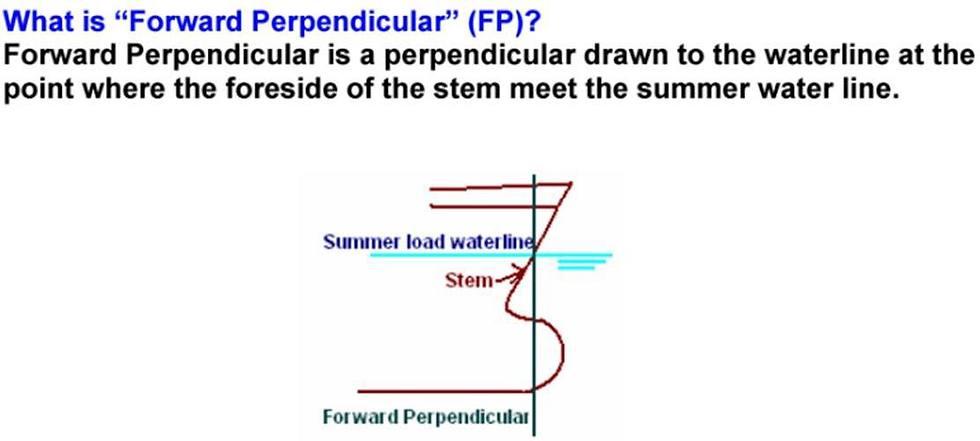
The Forward Perpendicular (FP) is an important reference line used in measuring a ship's length.
It is generally associated with the forward end of the ship at the relevant load line or waterline reference used for the vessel's dimensions.
In simple terms:
FP = Forward reference point used for ship length measurements.
The exact regulatory definition can depend on the applicable convention and ship type, so students should always refer to the relevant rules when working on actual ship calculations.
Aft Perpendicular
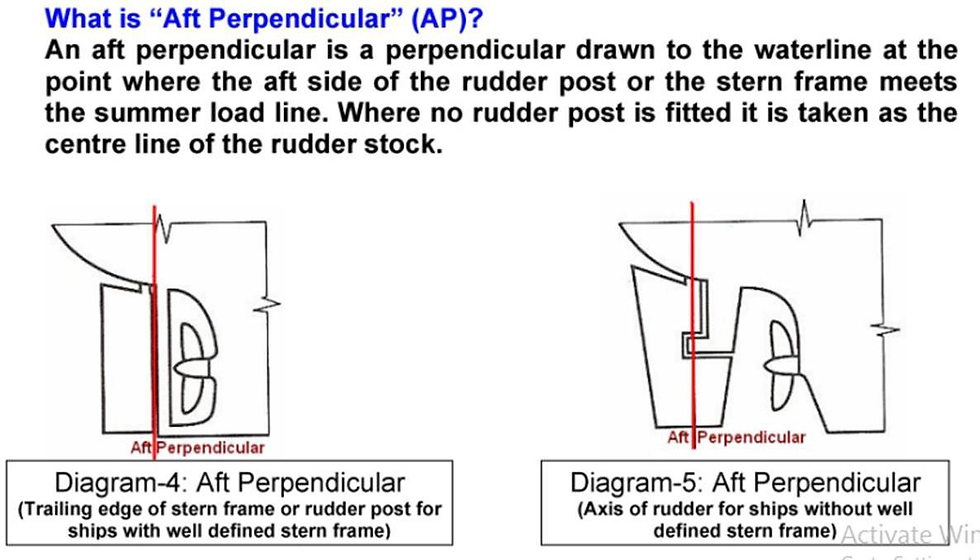
The Aft Perpendicular (AP) is the aft reference line used with the forward perpendicular to establish the ship's Length Between Perpendiculars (LBP).
Depending on the ship's stern arrangement, the aft perpendicular is associated with the rudder stock, rudder post or the relevant aft reference defined by the applicable rules.
Easy Way to Remember
FP = Forward referenceAP = Aft reference
The distance between them gives LBP.
Length Between Perpendiculars, LBP
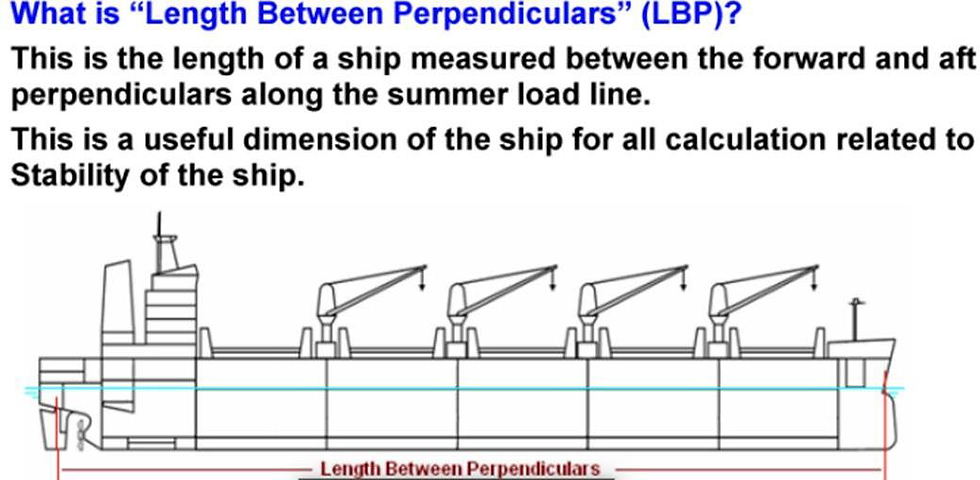
Length Between Perpendiculars (LBP) is the distance between the forward and aft perpendiculars.
It is commonly written as:
LBP = Distance between FP and AP
LBP is an important naval architectural dimension and appears in ship design, stability and regulatory calculations.
LBP vs LOA
These two terms should not be confused.
Term | Meaning |
LBP | Length between forward and aft perpendiculars |
LOA | Overall length of the vessel |
LWL | Length along a specified waterline |
Usually:
LOA ≥ LBP
The difference depends on the ship's bow and stern arrangement.
Length Overall, LOA
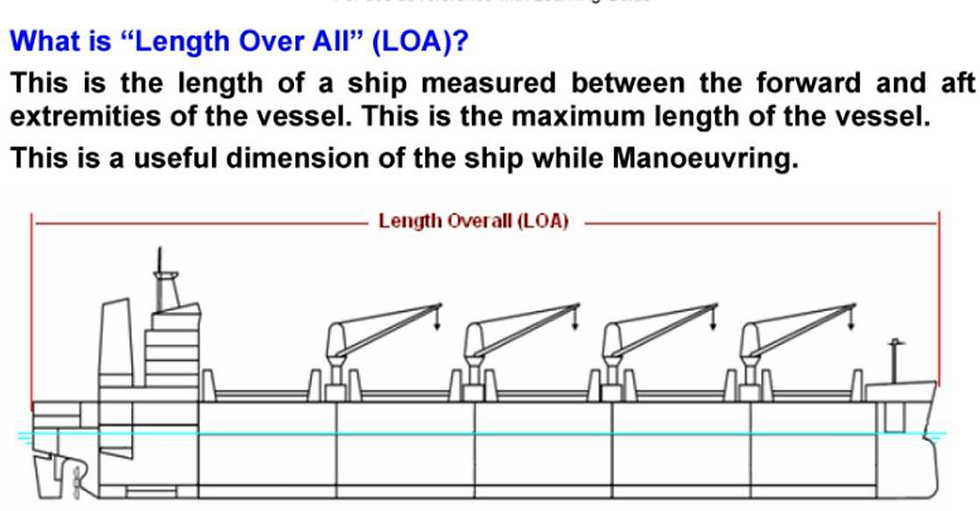
Length Overall (LOA) is the overall length of a vessel measured between its foremost and aftmost extremities.
LOA is particularly important in practical ship operations.
It is considered when dealing with:
Berthing
Dry-docking
Port restrictions
Canal dimensions
Turning areas
Shipyard facilities
Ship manoeuvring
Easy Way to Remember
LOA = Longest Overall Length
Length on Waterline, LWL
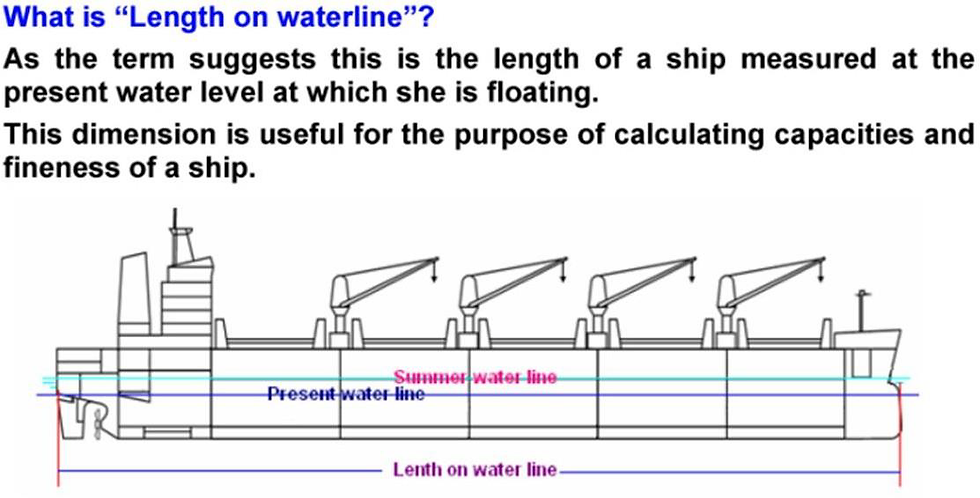
Length on Waterline (LWL) is the length of the ship measured along a specified waterline.
Unlike LOA, LWL can change with the ship's loading condition because the waterline changes with draught and trim.
LWL is important in studying:
Hull resistance
Wave-making characteristics
Ship speed
Froude number
Hull form
Hydrodynamic performance
Baseline
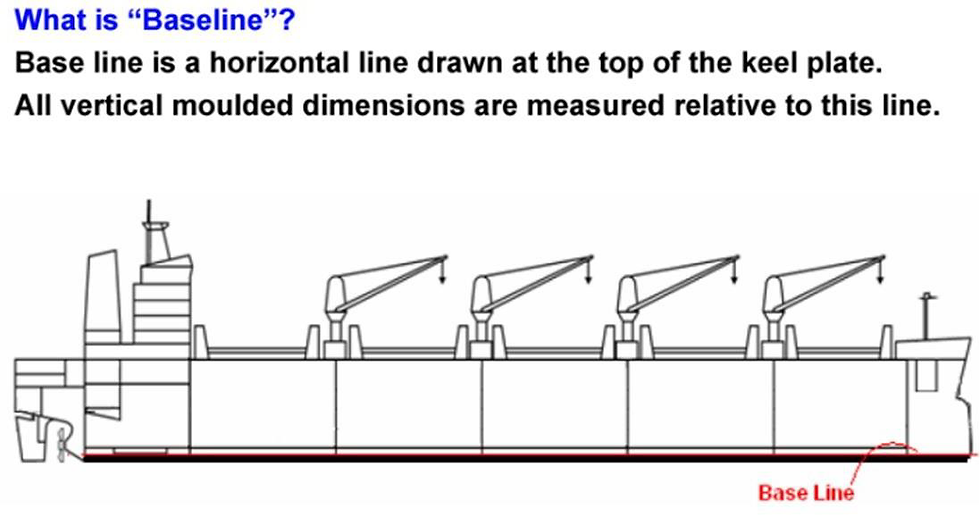
The baseline is a fundamental reference used for vertical measurements in ship design.
It provides a reference from which dimensions such as moulded depth and draught can be defined.
In simplified terms:
Baseline = Vertical reference starting point for many ship dimensions
The baseline is particularly important when reading:
Ship plans
Lines plans
General arrangement drawings
Structural drawings
Stability information
Breadth or Beam of a Ship
Breadth, commonly called beam, represents the width of the ship.
It is normally expressed in metres.
A larger beam can influence:
Initial stability
Cargo capacity
Deck area
Resistance
Manoeuvring characteristics
Structural design
However, beam alone does not determine stability. The complete hull form, centre of gravity, displacement and loading condition must also be considered.
Moulded Breadth
Moulded breadth is the breadth measured to the moulded surface of the ship's shell, according to the applicable measurement convention or rules.
Why Use Moulded Dimensions?
Moulded dimensions provide standardized reference dimensions for:
Ship design
Structural calculations
Stability
Tonnage measurement
Classification work
Extreme Breadth
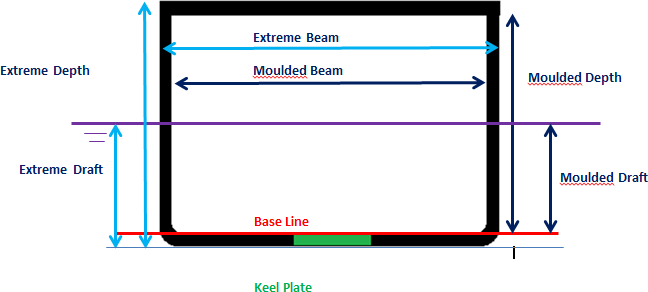
Extreme breadth is the maximum overall width measured across the vessel's outermost extremities.
It can therefore differ from moulded breadth because shell plating and external structures can affect the overall dimension.
Moulded vs Extreme Breadth
Moulded breadth: Measurement based on the moulded surface.
Extreme breadth: Overall external width.
Extreme dimensions are particularly useful when considering physical clearances.
Depth of a Ship
Ship depth is the vertical dimension between a defined baseline or keel reference and the relevant deck reference.
There are several different ways of defining depth, particularly when distinguishing between moulded depth and extreme depth.
Moulded Depth
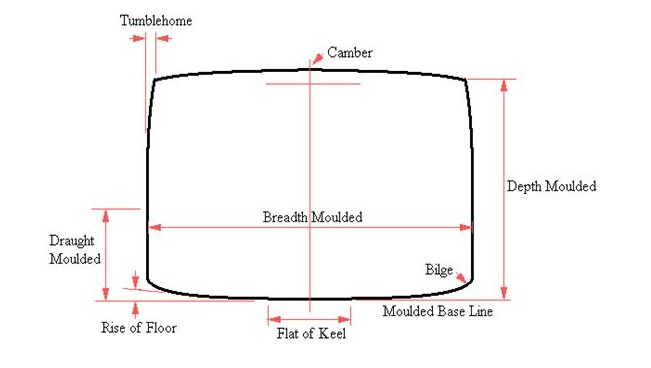
Moulded depth is a ship's vertical dimension measured from the defined keel or baseline reference to the appropriate moulded deck reference.
It is important in:
Ship design
Stability calculations
Structural calculations
Tonnage calculations
Classification requirements
The exact reference points should always be checked against the applicable rules for the vessel.
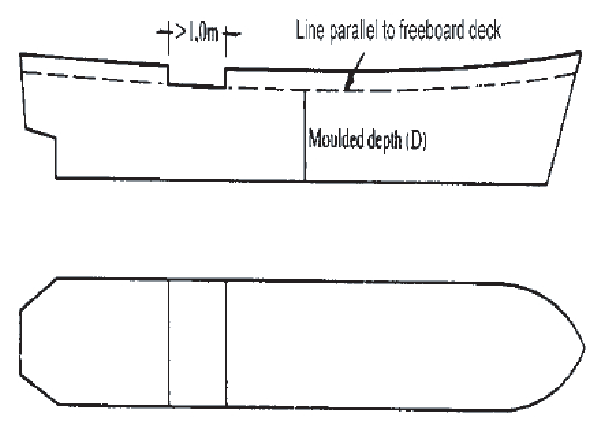
Extreme Depth
Extreme depth refers to the overall vertical dimension measured to the outermost structural extremities.
It is different from moulded depth because moulded measurements use specified reference surfaces rather than simply measuring the vessel's maximum physical dimension.
Draught or Draft
Draught, also spelled draft, is the vertical distance between the keel reference and the waterline.
In simple terms:
Draught tells us how deep the ship is sitting in the water.
For example, if a ship has a draught of 10 m, approximately 10 m of the vessel's vertical depth from the relevant keel reference lies below the waterline.
Why Is Draught Important?
Draught determines whether a ship can safely:
Enter a port
Pass through a channel
Navigate shallow water
Enter a dry dock
Load additional cargo
Operate under a particular load-line condition
Forward and Aft Draught
Ships can have different draughts at the forward and aft ends.
These are commonly recorded as:
Forward draught
Aft draught
Mean draught
The difference between forward and aft draught is related to trim.
Example
Forward draught = 8.0 mAft draught = 9.0 m
The ship has greater immersion aft.
The difference is:
Trim = 9.0 − 8.0 = 1.0 m
The sign convention for trim depends on the convention being used.
Trim
Trim describes the difference between a ship's forward and aft draughts.
A vessel may be:
Even keel
Trimmed by the bow
Trimmed by the stern
Trim is important during:
Cargo loading
Ballasting
Tank operations
Manoeuvring
Stability assessment
Propeller immersion considerations
Freeboard
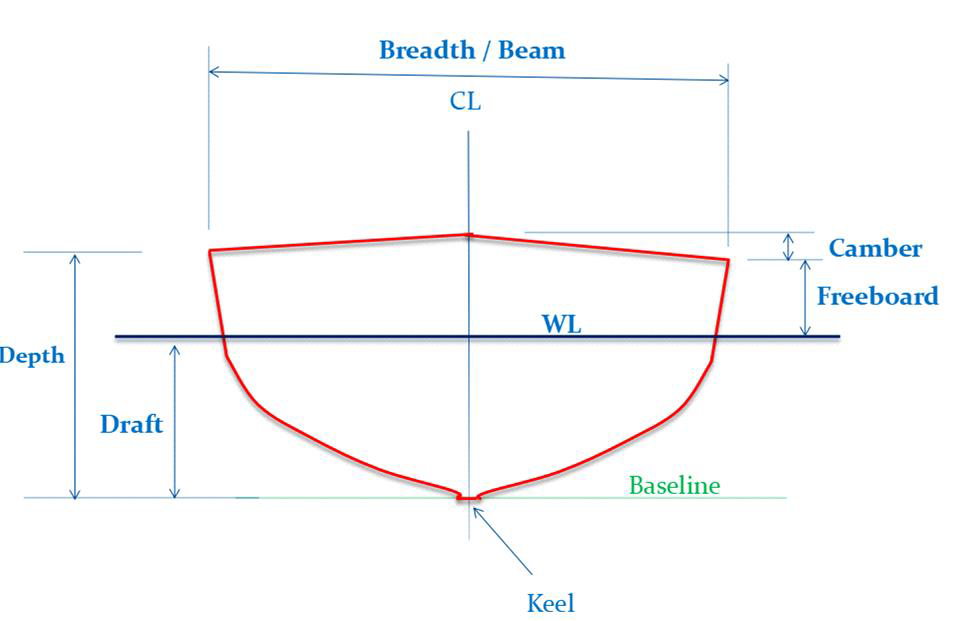
Freeboard is the vertical distance between the applicable waterline and the freeboard deck at the ship's side.
It is one of the most important safety-related dimensions of a ship.
Why Is Freeboard Important?
Freeboard contributes to reserve buoyancy and is an important component of the international load-line safety framework.
Freeboard is connected with:
Load line regulations
Reserve buoyancy
Watertight integrity
Weathertight integrity
Stability
Safe loading
Load Line
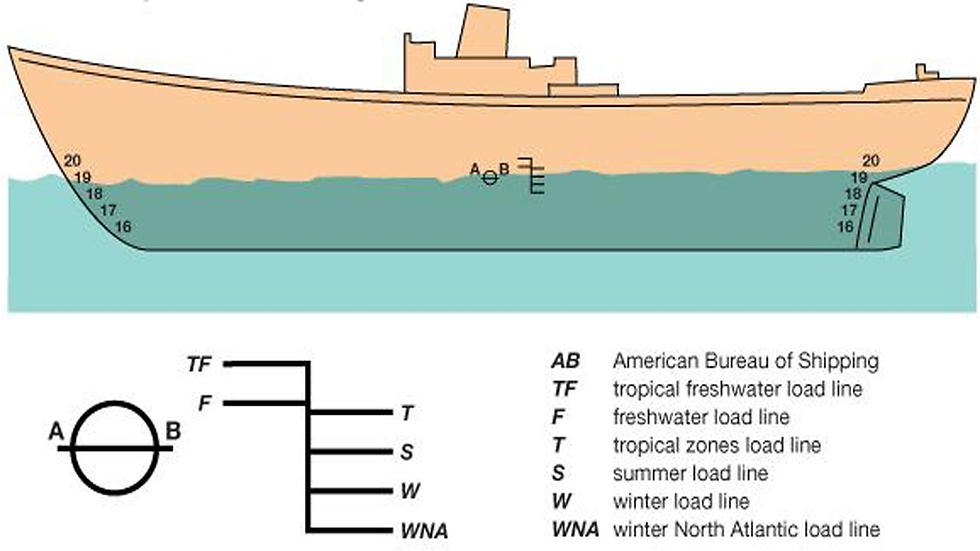
The load line indicates the maximum permissible draught under specified conditions.
The familiar load-line mark is placed amidships on each side of the vessel.
Different load-line marks can apply depending on the operating zone and season.
Examples include:
Tropical
Summer
Winter
Winter North Atlantic
Fresh Water
Tropical Fresh Water
Reserve Buoyancy
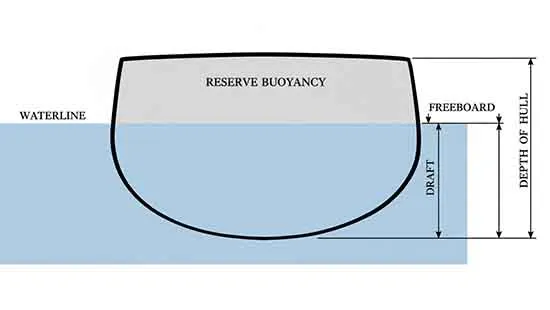
Reserve buoyancy is the volume of watertight or weathertight enclosed space above the waterline that can contribute to a vessel's ability to remain afloat as loading and sea conditions change.
Freeboard is therefore closely related to reserve buoyancy.
Camber
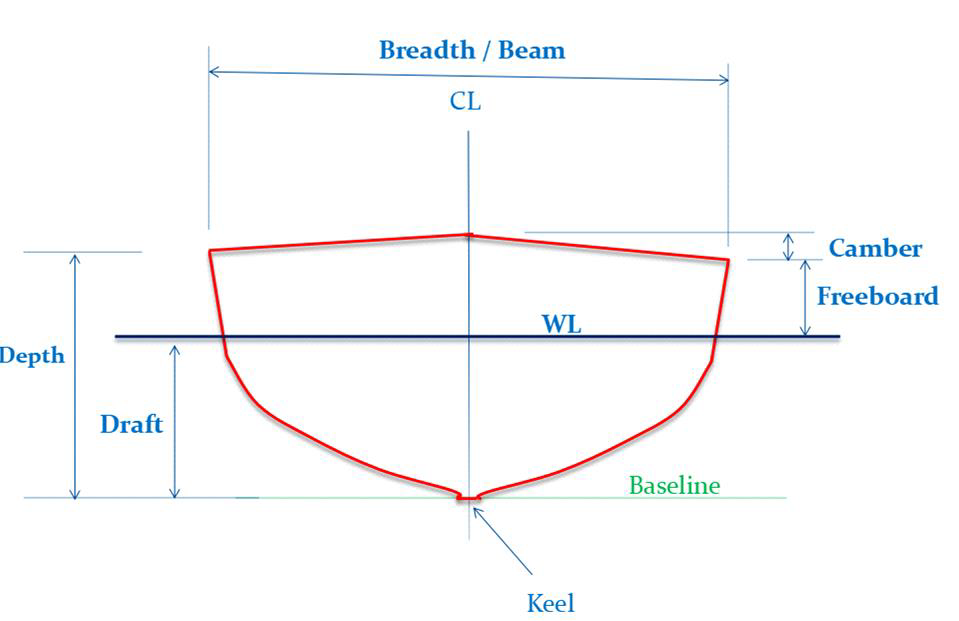
Camber is the transverse curvature of a ship's deck.
Instead of being completely flat from port to starboard, the deck may rise towards the centreline.
Why Is Camber Provided?
One major purpose is drainage.
When rainwater or seawater comes onto the deck, camber helps direct water towards the sides where it can be discharged through suitable arrangements.
Easy Way to Remember
Camber = Curvature across the width of the deck
Sheer
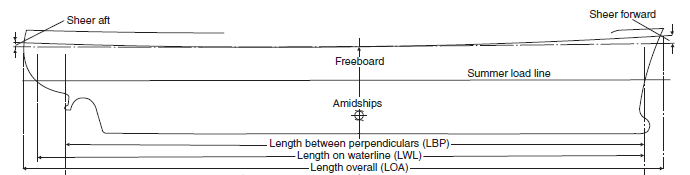
Sheer refers to the longitudinal rise of the deck towards the ends of the ship.
A ship's deck may be higher at the bow and stern than around midships.
Functions of Sheer
Sheer can:
Increase reserve buoyancy at the ends
Reduce the likelihood of the bow becoming deeply immersed
Improve protection against waves coming onto the deck
Contribute to seaworthiness and hull form
Easy Way to Remember
Sheer = Curvature along the length
Camber = Curvature across the width
Flare
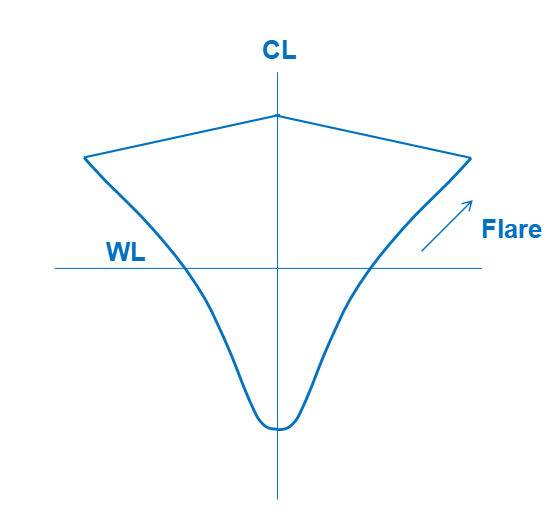
Flare refers to the outward inclination or curvature of the ship's sides as they rise above the waterline.
It is particularly noticeable towards the bow of many ships.
Functions of Flare
Flare can:
Deflect spray
Help keep the forward deck drier
Increase reserve buoyancy above the waterline
Influence the vessel's seakeeping behaviour
Tumblehome
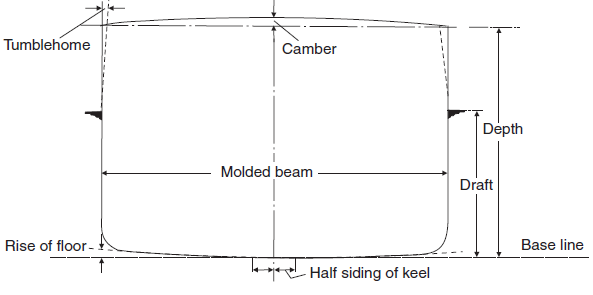
Tumblehome is the opposite of flare.
Instead of the ship's side moving outward as it rises, the side curves inward above the waterline.
Simple Comparison
Flare: Side moves outward upward.
Tumblehome: Side moves inward upward.
Rise of Floor or Deadrise
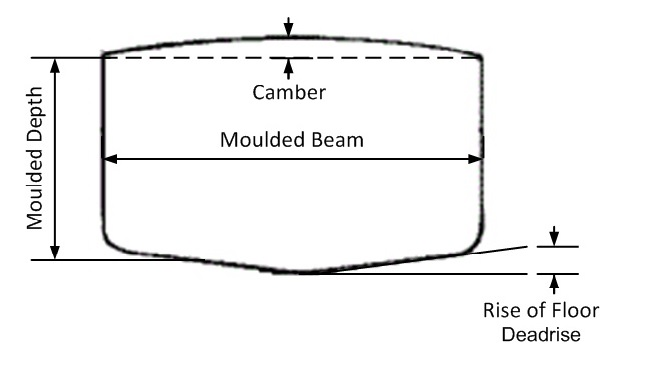
Rise of floor, often associated with deadrise, describes the upward rise of the bottom plating from the keel region towards the sides.
It is a feature of the transverse hull shape.
Deadrise can influence:
Hull geometry
Water flow
Stability characteristics
Draft distribution
Construction
Stem Rake
The stem is the structural member or forward boundary forming the front of the hull.
When the stem is inclined rather than vertical, the inclination is referred to as stem rake.
A raked stem can significantly change the visual profile and hydrodynamic characteristics of the bow.
Keel Rake
Keel rake refers to the inclination of the keel line from the horizontal reference.
Different vessel types can use different keel arrangements depending on their operational requirements.
Half Siding of Keel
Half siding of keel refers to the horizontal width of the flat keel area measured from the vessel's centreline, depending on the applicable ship construction terminology.
It can be relevant when examining:
Dry-docking arrangements
Keel block positioning
Hull construction
Shipyard drawings
Midships
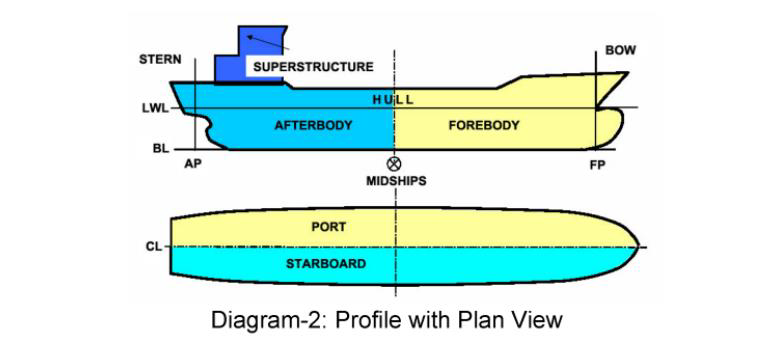
Midships is an important reference location along the length of a ship.
For many standard ship measurements, it is associated with the midpoint of the ship's reference length.
Midship sections are particularly important in naval architecture because they provide a representative cross-section of the vessel's hull.
Forebody and Afterbody
A ship's hull can broadly be divided into two portions around midships.
Forebody
The portion forward of midships.
Afterbody
The portion aft of midships.
The shape of both sections has a major effect on:
Resistance
Propulsion efficiency
Seakeeping
Manoeuvrability
Propeller and rudder flow
Bow and Stern
Bow
The bow is the forward end of the ship.
The bow is designed to move through the water efficiently while providing suitable buoyancy and seakeeping characteristics.
Stern
The stern is the aft end of the ship.
The stern accommodates or supports important components such as:
Propeller
Rudder
Stern structure
Steering arrangements
depending on vessel design.
Port and Starboard
These are the two standard terms used to identify the sides of a vessel.
Port = left side when facing forward
Starboard = right side when facing forward
Easy Way to Remember
Port and left both have four letters.
Hull
The hull is the main body of the vessel.
It provides the structure required to:
Support the ship's machinery and equipment
Carry cargo
Provide buoyancy
Resist external loads
Provide a hydrodynamically suitable underwater form
The hull includes structural elements such as:
Shell plating
Frames
Decks
Bulkheads
Keel structure
Longitudinal members
Transverse members
Displacement
Displacement is the mass of water displaced by a floating vessel and, under the conditions of flotation, corresponds to the vessel's total mass.
In simple terms:
Displacement = Total weight of the ship at a particular loading condition
It changes as the ship takes on or removes:
Cargo
Fuel
Fresh water
Ballast
Stores
Other consumables
This is different from deadweight.
Lightship Weight
Lightship represents the weight of the vessel in a specified lightship condition.
It generally includes the ship's structure, machinery and permanent equipment, while excluding variable loads such as cargo, consumable liquids and similar items.
A useful simplified expression is:
Lightship = Hull + Machinery + Permanent Equipment/Outfit
Deadweight Tonnage, DWT
Deadweight Tonnage (DWT) represents the carrying capacity of a ship in terms of the total mass of cargo and other variable loads that can be carried up to the relevant loaded condition.
A simplified relationship is:
DWT = Loaded displacement − Lightship
Deadweight can include:
Cargo
Fuel oil
Diesel oil
Lubricating oil
Fresh water
Ballast water
Stores
Crew
Passengers and effects, where applicable
Important Distinction
DWT is not the ship's physical weight.
It represents the variable load-carrying capacity associated with a particular displacement condition.
Gross Tonnage and Net Tonnage
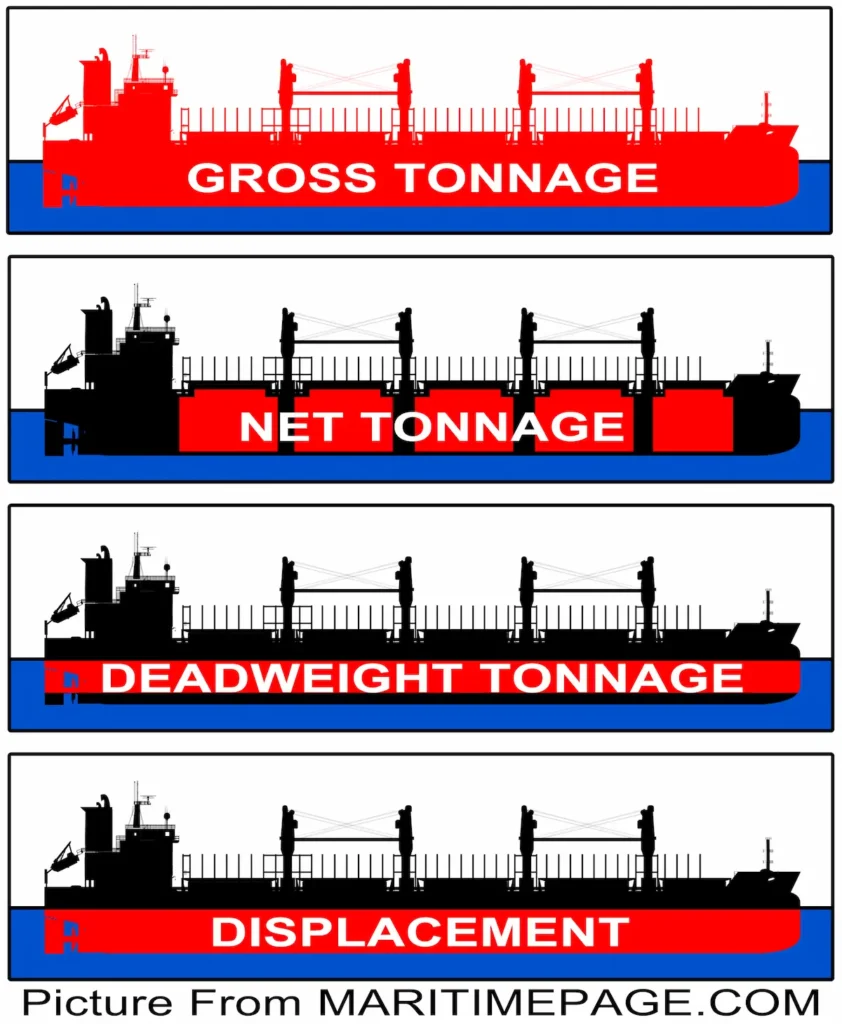
Gross Tonnage and Net Tonnage are frequently misunderstood because the word "tonnage" can make people think they represent weight.
They do not directly represent the ship's weight.
Gross Tonnage (GT) is based on the moulded volume of enclosed spaces, while Net Tonnage (NT) is derived from the volume of cargo spaces using the prescribed tonnage measurement formula.
Gross Tonnage, GT
GT is related to the overall moulded volume of enclosed spaces.
It is used in areas including:
Registration
Manning regulations
Safety regulations
Port dues
Net Tonnage, NT
NT is related primarily to the volume of cargo spaces under the prescribed tonnage measurement formula.
Remember
DWT = Mass-based carrying capacity
GT/NT = Volume-based tonnage measurements
TEU and FEU
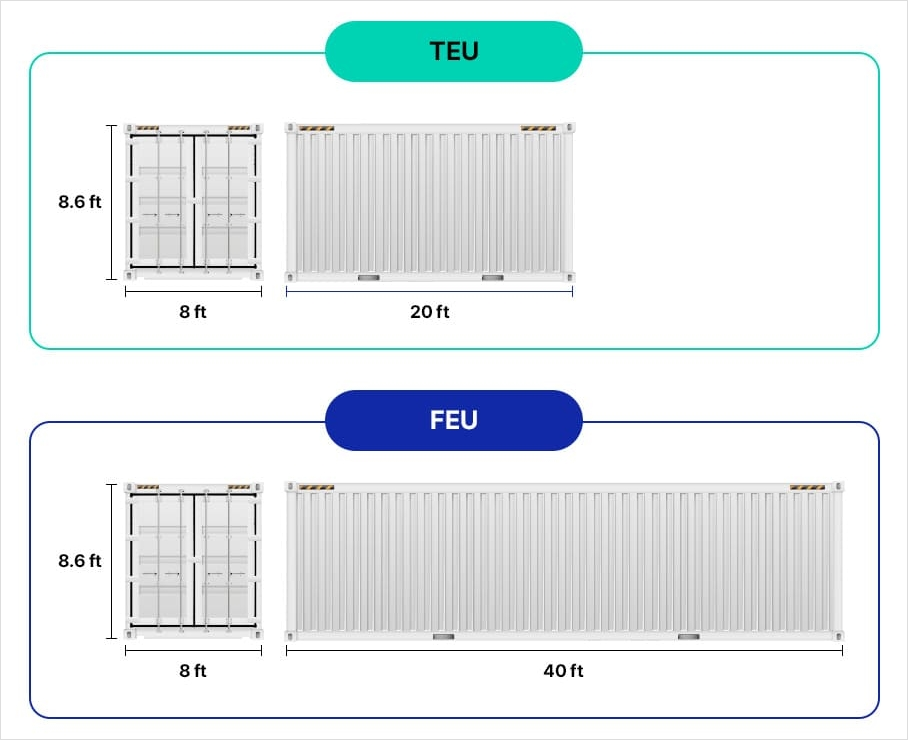
Container ships often use TEU and FEU to describe container capacity.
TEU
TEU = Twenty-foot Equivalent Unit
One standard 20-foot container corresponds to one TEU.
FEU
FEU = Forty-foot Equivalent Unit
A standard 40-foot container is generally counted as two TEU.
Therefore:
1 FEU ≈ 2 TEU
These units allow container capacity to be compared using a common standard.
Important Ship Dimensions at a Glance
Term | Meaning |
FP | Forward perpendicular |
AP | Aft perpendicular |
LBP | Length between perpendiculars |
LOA | Length overall |
LWL | Length on waterline |
B | Breadth or beam |
D | Depth |
T | Draught |
F | Freeboard |
GT | Gross tonnage |
NT | Net tonnage |
DWT | Deadweight tonnage |
DWL | Design waterline |
Moulded vs Extreme Dimensions
One of the most important concepts for students is understanding the difference between moulded and extreme dimensions.
Moulded Dimension | Extreme Dimension |
Based on defined moulded reference surfaces | Based on outermost physical extremities |
Used extensively in naval architecture | Useful for overall physical clearance |
Used in regulatory and design calculations | Important for docking and external clearance |
Standardized reference measurement | Represents overall external dimension |
For example:
Moulded breadth and extreme breadth are not necessarily the same.
Similarly, the precise definition of moulded depth depends on the relevant measurement convention.
Why Ship Dimensions Are Important in Real Operations
Ship dimensions are not only theoretical values found in textbooks.
They have direct operational applications.
Port Operations
LOA, beam and draught determine whether a vessel can safely use a particular berth or channel.
Dry Docking
The shipyard needs information about:
LOA
Beam
Draught
Keel configuration
Docking plan
Cargo Operations
DWT, draught and stability information are essential for loading cargo safely.
Stability
Dimensions such as beam, depth and draught influence the vessel's hydrostatic characteristics.
Canal Transit
LOA, beam, draught and air draft can determine whether a vessel can use a particular waterway.
Ship Design
Naval architects use dimensions to develop the vessel's hull form and assess performance.
Classification and Regulations
Ship dimensions are used in various calculations and regulatory requirements.
How Ship Dimensions Affect Stability
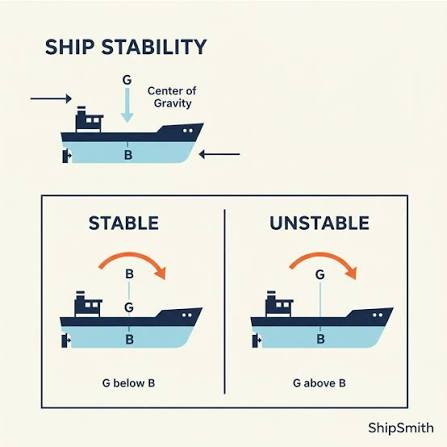
Ship dimensions are closely connected with stability.
For example, beam can have a significant influence on initial stability, while draught and underwater hull form influence the vessel's hydrostatic characteristics.
However, it is incorrect to assume that simply increasing one dimension automatically makes a ship more stable. Stability depends on the complete relationship between:
Centre of gravity
Centre of buoyancy
Metacentric height
Displacement
Hull geometry
Loading condition
Free surface effects
Trim
This is why ship stability is studied using hydrostatic data rather than relying on individual dimensions alone.
Ship Dimensions and the Load Line
One of the most important practical connections is between draught and freeboard.
As a ship is loaded:
Cargo increases → Displacement increases → Draught increases → Freeboard decreases
Therefore, a ship cannot simply continue loading indefinitely.
International Load Line requirements establish limits intended to prevent excessive loading and maintain adequate safety margins.
Common Mistakes Students Make
Confusing LOA with LBP
LOA is the overall length.
LBP is the length between the defined perpendiculars.
Thinking DWT Is the Ship's Total Weight
DWT represents the ship's deadweight carrying capacity at a specified loading condition.
Thinking GT Means Weight
GT is a volume-based measurement.
Confusing Draught and Freeboard
Draught = Distance into the water
Freeboard = Distance above the water to the relevant freeboard deck
Confusing Camber and Sheer
Camber = Transverse curvature
Sheer = Longitudinal rise
Confusing Flare and Tumblehome
Flare = Outward
Tumblehome = Inward
Easy Memory Tricks for Ship Terminology
LOA
L = Longest Overall
LBP
Length Between Perpendiculars
Camber
C = Crosswise curvature
Sheer
S = Ship's longitudinal rise
Flare
F = Flares outward
Tumblehome
T = Turns inward toward the top
Draught
How deep the ship goes
Freeboard
How much ship remains above the water
DWT
Deadweight = What the ship can carry
GT
Gross Tonnage = Enclosed volume-based measurement
Frequently Asked Questions About Ship Dimensions
What is LOA in a ship?
LOA stands for Length Overall. It is the overall length of the vessel from its foremost to aftmost extremities.
What is LBP?
LBP stands for Length Between Perpendiculars. It is the distance between the forward and aft perpendiculars.
What is the difference between LOA and LBP?
LOA represents the overall physical length of the ship, while LBP is measured between defined forward and aft perpendiculars.
What is ship's beam?
Beam is another commonly used term for the ship's breadth, or width.
What is draught of a ship?
Draught is the vertical distance from the relevant keel reference to the waterline.
What is freeboard?
Freeboard is the vertical distance between the applicable waterline and the freeboard deck at the ship's side.
Why is freeboard important?
Freeboard contributes to reserve buoyancy and is an important component of the international load-line safety framework.
What is camber in a ship?
Camber is the transverse curvature of a ship's deck, generally provided partly to facilitate drainage.
What is sheer in a ship?
Sheer is the longitudinal rise of the deck towards the ends of the vessel.
What is flare?
Flare is the outward inclination or curvature of the ship's sides above the waterline, particularly noticeable towards the bow.
What is tumblehome?
Tumblehome is the inward curvature of the ship's sides above the waterline.
What is DWT?
DWT stands for Deadweight Tonnage. It represents the mass of cargo and other variable loads that a ship can carry to its relevant loaded condition.
Is gross tonnage the weight of a ship?
No. Gross Tonnage is a measurement based on the moulded volume of enclosed spaces. It is not the ship's weight.
What is the difference between DWT and GT?
DWT is a mass-based measure associated with the ship's deadweight carrying capacity, whereas GT is a volume-based tonnage measurement.
What does TEU mean?
TEU means Twenty-foot Equivalent Unit and is used to express container capacity.
What does FEU mean?
FEU means Forty-foot Equivalent Unit. A standard 40-foot container is generally equivalent to two TEU.
What is port and starboard?
Port is the left side of the ship when facing forward. Starboard is the right side when facing forward.
Why are ship dimensions important for marine engineers?
Ship dimensions help marine engineers understand loading conditions, machinery requirements, stability information, dry-docking requirements, propulsion arrangements and the operational limitations of the vessel.