SCBA on Ships: Parts, Working Principle, Donning, Checks and Maintenance Explained


When a fire breaks out in an engine room or a crew member collapses inside an enclosed space, the air itself can become the biggest threat. Smoke, toxic gases and oxygen deficiency can disable a person within moments. This is exactly why the Self-Contained Breathing Apparatus, commonly called SCBA, is one of the most important pieces of safety gear on any vessel.
SCBA is used by firefighters, paramedics, rescue teams and seafarers working on ships and offshore rigs. It gives the wearer a clean, independent supply of breathable air, so they can work safely in places where the surrounding atmosphere cannot be trusted.
In this guide, we explain what SCBA is, the main types, its parts, how long the air lasts, and how to assemble, wear, test and maintain it correctly.
What Is a Self-Contained Breathing Apparatus (SCBA)?
An SCBA is a portable breathing system that supplies air from a cylinder carried on the wearer's back. The word "self-contained" means the user does not depend on any outside air source or long hose. Everything needed for breathing travels with the person.

Onboard ships, SCBA is used for:
Firefighting operations
Entry into enclosed or poorly ventilated spaces
Rescue of trapped or injured persons
Emergency response in smoke or toxic gas
Types of SCBA: Open Circuit and Closed Circuit
There are two major types of SCBA in use today.
Open circuit SCBA supplies compressed air from a cylinder. The wearer inhales this air through a demand valve, and the exhaled air is released straight into the atmosphere. This is simple, reliable and the type used on ships.
Closed circuit SCBA recycles the exhaled air, removes carbon dioxide and tops it up with oxygen. This is often called a rebreather. Because the air is reprocessed, a closed circuit set can last much longer, which makes it better suited to extended rescue operations.
Remember: the SCBA carried on board merchant ships is of the open circuit type.
Main Parts of an SCBA
A standard open circuit SCBA set includes the following components.

1. Air Cylinders
One or two cylinders hold air under high pressure. A typical cylinder contains about 1240 litres of compressed air at 200 bar. Cylinders must be checked after every use and refilled so that the set is always ready for the next emergency. Spare cylinders must be provided for every set.
2. Harness and Backplate
The harness mounts the cylinder on the wearer's back. It includes shoulder straps and a waist belt that distribute the weight and keep the set steady during movement.
3. Reducing Valve and Demand Valve
The reducing valve lowers the high cylinder pressure to a working level. The demand valve, which is attached to the facemask, then supplies air only when the wearer inhales. It also maintains slight positive pressure inside the mask, so that any leak pushes air out rather than letting toxic air in.
4. Facemask
The facemask is made of soft moulded rubber with a shatterproof full vision visor. It has five adjustable head straps, a nylon neck strap, a foam or air cushion seal, a nose guard and an exhalation port with a speech diaphragm. The wearer should always have a clear field of vision.
5. Exhalation Valve
This valve lets exhaled air leave the facemask while preventing outside air from entering.
6. Pressure Gauge
A gauge clipped to the harness shows the pressure left in the cylinder. It is positioned so the wearer can read it easily during operations.
7. Warning Whistle (Alarm)
When the air is running low, a whistle sounds continuously until the cylinder is empty. It is typically set to activate at around 55 bar (plus or minus 5 bar), which leaves roughly 10 minutes of air. When it sounds, the wearer must leave the hazardous area immediately.
8. Protective Hood
A protective hood covers the head and neck, working together with the mask to shield the wearer from heat and flames.
9. Portable Transporting Bag and Hauling Bag
The transporting bag carries cylinders, hoods and other protective items to the scene. The larger hauling bag carries extra weight and moves the equipment from the base or locker to the incident site. At the site, the gear is transferred to the smaller transporting bag.
How Long Does an SCBA Cylinder Last?
Air duration depends on how hard the wearer is working. Heavy work and nervousness raise the breathing rate, so the air is used faster.
Level of work | Air consumption (litres per minute) | Duration, 1200 litre cylinder (minutes) | Duration, 1800 litre cylinder (minutes) |
Resting | 8 to 12 | 150 to 100 | 225 to 150 |
Light work | 12 to 20 | 100 to 60 | 150 to 90 |
Moderate work | 20 to 40 | 60 to 30 | 90 to 45 |
Heavy work | 40 to 60 | 30 to 20 | 45 to 30 |
Formula for Nominal Working Duration
Nominal working duration (minutes) = (Cylinder capacity in litres ÷ 40) minus 10
The 10 minutes are subtracted because that is the reserve time when the alarm begins to sound, and it must be kept as a safety margin.
Example: A 1200 litre cylinder gives 1200 ÷ 40 = 30 minutes. After subtracting the 10 minute reserve, the usable working time is 20 minutes.
A cylinder of about 1240 litres at 200 bar gives roughly 31 minutes of air for full use, or about 21 minutes in real working conditions.
Assembly Instructions
Open the cylinder cradle by squeezing both sides of the cradle lever and opening the cylinder strap.
Line up the cylinder valve with the reducer valve handwheel and turn the handwheel counterclockwise until it is hand-tight.
Hook the cylinder strap over the cylinder and pull the operating lever down onto the tension spring until it clips in place.
To attach the demand valve to the facemask, line up the assembly with the red bypass knob facing upward, aligned with the centreline of the mask.
Turn the assembly clockwise through 90 degrees until it clicks into place.

How to Don an SCBA: Step by Step
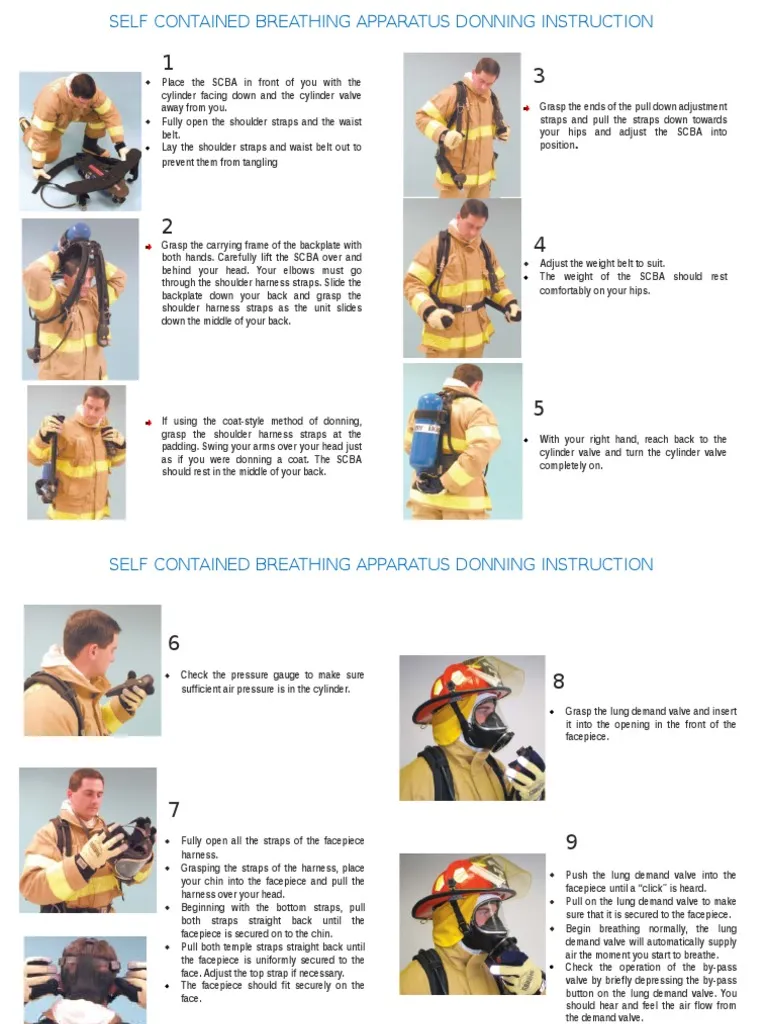
Hang the facemask around your neck using the neck strap.
Lift the set over your head with the cylinder valve at the top and the backplate facing you, then slide your arms through the shoulder straps.
Tighten the shoulder straps and fasten the waist belt.
Slowly open the cylinder valve by turning the handwheel counterclockwise.
Check the pressure on the gauge.
Loosen all facemask straps fully, hold your breath, place your chin into the mask and pull the head harness over your head.
Make sure the nose guard sits correctly on the nose.
Tighten the straps in sequence: the upper pair first, then the middle pair, and finally the lower pair. Do not over-tighten, as this causes discomfort.
Begin breathing deeply to activate positive pressure, then settle into slow, steady breaths.
Important: If the facemask comes off in a toxic atmosphere, hold your breath and refit it immediately. Even a small amount of toxic air can be extremely dangerous.
Pre-Use Checks
Perform these checks every time before using the set, and after every round of maintenance.
Close the cylinder valve.
Breathe normally to vent the system.
While venting, watch the gauge. The whistle alarm should sound at the preset pressure of 55 bar, plus or minus 5 bar.
When the gauge reads zero, hold your breath. The facepiece should stay sealed to your face, which confirms a positive seal.
Open the cylinder valve slowly but fully to pressurise the system.
Inhale and hold your breath. There should be no audible leak.
Continue breathing. Exhaled air should flow easily out through the exhalation valve.
Press the centre of the rubber cover on the demand valve to check the supplementary air supply.
Rules While Using the SCBA

Start only with cylinders that are at least 80 percent full.
Check the gauge regularly.
If the whistle sounds, move at once to a safe area with fresh air.
Never remove the apparatus until you are in a safe area.
Stay calm. Nervousness and excitement increase the breathing rate and drain the air faster.
Procedure After Use
Press the reset lever and switch the set off.
Press and hold the button, then remove the demand valve.
Insert a finger behind the neck strap and press the buckles forward. Pull the mask forward, then up and back over the head.
Close the cylinder valve and remove the facepiece.
Unbuckle the waist belt and remove the equipment once the shoulder straps loosen.
Refill or replace the cylinder so the set is ready again.
Alarm Testing Procedure
Open the cylinder valve. The line will pressurise to about 200 bar, which the gauge will show.
Close the cylinder valve.
Check that the pressure does not drop by more than 10 bar within one minute. A bigger drop indicates a leak.
Open the demand valve slowly so that the pressure in the high pressure line starts to fall.
When the pressure reaches 50 to 60 bar, the alarm should sound. This signals that only about 10 minutes of air remain for escape.
Routine Checks and Maintenance Schedule
A breathing apparatus is only useful if it works perfectly on the day it is needed. Good maintenance is not optional.
Frequency | Task |
After every use | Inspect the set, clean the mask, refill cylinders and repeat pre-use checks |
Monthly | Thorough visual inspection of the entire set |
Yearly | Check all valves, seals and speech membranes |
Every 2 years | Replace the exhalation disc |
Every 5 years | Send the complete apparatus for a full service and overhaul |
Day to day care tips:
Check the backplate, shoulder straps and waist belt for damage, and keep the straps fully stretched out.
Inspect the facemask straps and all rubber parts for signs of deterioration.
Wipe the mask with a mild disinfectant, rinse under running water and dry it fully.
Keep a small air compressor on board to refill cylinders, along with spare cylinders for each set.
Why SCBA Matters for Ship Safety

Firefighting and enclosed space entry are two of the most dangerous jobs at sea. A properly maintained SCBA, used by a trained crew member, can mean the difference between a successful rescue and a tragedy. Regular drills, careful checks and strict discipline with the equipment build the confidence needed when a real emergency arrives.
Frequently Asked Questions (FAQ)
What does SCBA stand for?
SCBA stands for Self-Contained Breathing Apparatus. It is a portable device that supplies breathable air to the wearer in smoke, toxic gas or oxygen deficient atmospheres.
Which type of SCBA is used on ships?
Ships use the open circuit SCBA. Air from the cylinder is inhaled through a demand valve, and the exhaled air is released into the atmosphere.
How long does an SCBA cylinder last?
A cylinder holding about 1240 litres of air at 200 bar lasts roughly 31 minutes under full use, or about 21 minutes in real working conditions. Heavy work and stress shorten this time.
At what pressure does the SCBA warning whistle sound?
The alarm usually sounds at about 55 bar, plus or minus 5 bar. This leaves roughly 10 minutes of air, and the wearer should leave the area immediately.
What should I do if my facemask comes off in a toxic atmosphere?
Hold your breath, refit the mask correctly and clear it by breathing. Never inhale while the mask is dislodged.
How often should an SCBA be inspected?
Carry out a visual inspection every month, check valves, seals and speech membranes every year, replace the exhalation disc every two years, and send the full set for overhaul every five years.
What is the minimum cylinder pressure before using an SCBA?
The cylinder should be at least 80 percent full before use.
Why is a positive pressure demand valve important?
It keeps the pressure inside the mask slightly higher than outside, so any small leak pushes clean air out instead of allowing toxic air in.
Do ships need spare SCBA cylinders?
Yes. Spare cylinders must be provided for each set, and a small air compressor must be available on board to refill them.