Internal Hardware Hackathon 2026: Cultivating Young Maritime Talents at IMU Kolkata

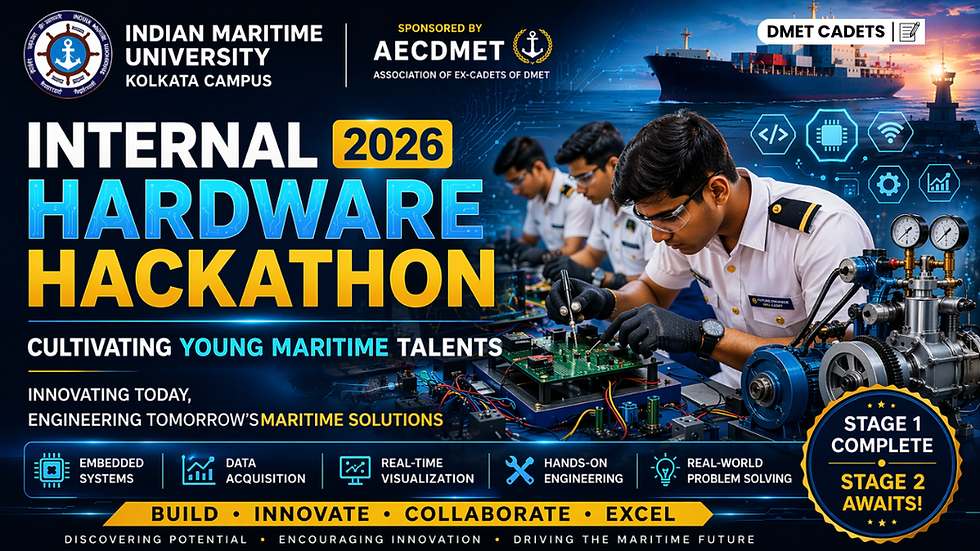
The Internal Hardware Hackathon 2026 at the Indian Maritime University (IMU), Kolkata Campus, marked a significant step toward nurturing the next generation of maritime engineers. Designed to promote hands-on learning, embedded systems, and real-world problem-solving, the event successfully concluded its Stage 1 screening phase between 7th and 14th February 2026, setting a high benchmark for technical innovation among cadets.
Purpose of Stage 1: Building Strong Engineering Foundations

Sponsored by the Association of Ex-Cadets of DMET (AECDMET), the hackathon aimed to identify cadets with a natural aptitude for data acquisition systems (DAQ), embedded programming, and mechanical system analysis. With 70 cadets participating in 14 teams, the competition saw enthusiastic engagement from first-year students, many of whom were experiencing such technical exposure for the first time.

The core objective of Stage 1 was to design and develop a functional DAQ system using provided hardware components. The system was expected to log real-time sensor data into a CSV file and display it through a visual interface. This approach ensured that cadets not only understood theoretical concepts but also applied them in practical scenarios.
Equipment and Technical Implementation
To maintain fairness and standardization, each team was equipped with identical hardware, including:
ESP-32 Microcontroller
BMP280 Digital Pressure Sensors
HC-SR04 Ultrasonic Module
IR Sensors and Potentiometers
Perforated PCBs and soldering tools
Cadets demonstrated impressive technical capabilities by implementing communication protocols such as SPI and I2C for sensor integration, along with ADC conversions for analog inputs. Data visualization emerged as a highlight, with teams developing dashboards using HTML, Python, JavaScript, and C++.
One standout team went a step further by creating a fully Python-based visualizer using Tkinter and Matplotlib, showcasing deep programming proficiency and innovation.
Evaluation Criteria and Performance
The evaluation process was comprehensive, focusing on:
Sensor functionality and accuracy
Data logging and visualization
Soldering quality and circuit design
Wireless communication capabilities
Teams were graded across Passing, Distinction, and High Distinction levels, depending on their performance and additional features such as real-time visualization and PCB design.
The results were remarkable—13 out of 14 teams successfully completed their projects, highlighting the strong technical potential among IMU cadets. Additionally, exceptional individuals were recognized with Wild Card Entries, ensuring that talent was not overlooked due to team limitations. Key Outcomes: Innovation Meets Maritime Engineering
The hackathon successfully uncovered talent across multiple domains:
Embedded programming (C/C++, Python)
Electronics and circuit design
Data visualization and system integration
Interestingly, cadets were allowed to use AI tools, provided they understood the underlying logic. This encouraged smart learning and practical application, aligning with modern engineering practices.
Stage 2: The Ultimate Engineering Challenge
With Stage 1 setting the foundation, Stage 2 promises to be a real-world engineering test. Scheduled for the upcoming semester, this phase will involve working with a live mechanical test rig, including:
Single-cylinder, 4-stroke, air-cooled engine
Carburetor system
2-stage reciprocating air compressor
Participants will develop advanced DAQ systems using STM Blackpill and ESP-01 WiFi modules, capturing critical parameters such as:
Cylinder block temperature
Exhaust gas temperature and pressure
Shaft RPM and compressor pressures
Optional challenges like fault diagnosis and custom PCB design using KiCad will further test the depth of their knowledge.
Safety and Professional Standards

Given the involvement of live machinery and fuel, strict safety protocols are in place. Mandatory PPE, controlled fuel usage, emergency kill switches, and fire safety systems ensure a secure and professional working environment, preparing cadets for real maritime operations.
Conclusion: Shaping Future Maritime Innovators
The Internal Hardware Hackathon at IMU Kolkata is more than just a competition—it is a platform for innovation, collaboration, and skill development. By integrating electronics, programming, and mechanical systems, the event bridges the gap between classroom learning and industry requirements.

As Stage 2 approaches, the excitement builds for what promises to be an even more challenging and rewarding experience. Initiatives like these are crucial in cultivating young maritime talents, ensuring that the future of the maritime industry is driven by skilled, innovative, and safety-conscious engineers.


