From Cadets to Officers: The March in Whites
- DMET Cadets

- 2 days ago
- 5 min read

The sun was already up over Taratala Road when the boots started hitting the ground. Not randomly, in step, together, the way they had been practicing for two weeks straight. On the morning of 13th March 2026, the parade ground at P-19 Taratla Road, Indian Maritime University Kolkata Campus held something it holds only once a year: the particular silence of an institution holding its breath. The Batch of 2022–26 was passing out.
Two hundred and eighty cadets who had walked through those gates four years ago as nervous teenagers, half-excited, half-terrified, stood that morning in pressed whites, shoulders square, chins level. Engineering Officers, each one of them. Not just on paper, but in the way they carried themselves. You could see it.
Why a Parade, and NOT Just a Convocation?
It is a fair question. These graduates had studied thermodynamics, naval architecture, and electrical systems with the same rigour as any engineering student in the country. They had cleared examinations, submitted reports, and logged hours in the workshop. By all conventional measures, a convocation would have sufficed. But a maritime institution is not a conventional place, and these were not conventional graduates. From their very first weeks here, the days began before dawn. Physical training before breakfast. Drills, inspections, and parade practice are layered over an already demanding academic schedule. They learned to work with real machinery and real systems, and they learned, alongside all of that, what it means to be responsible for something larger than yourself. A stage and a rolled certificate cannot capture any of that. A Passing Out Parade: sharp, ceremonial, solemn, is the only language that fits.

For every senior cadet, this day also carries something else: the chance to be recognised. The Best Cadet Award, the Best Academia Award, and other honours that are not handed out lightly are earned through years of consistent effort. That, too, makes the day one that every batch counts down to.
The Rehearsals Nobody Sees
The parade on the day lasted under an hour. The parade behind the parade, the one that actually made it possible, stretched across a training period of years.
The fourth-year cadets had four years of institutional muscle memory to draw on. For the junior batches, who bore the weight of organising and running the event, it was a different story. Early practice sessions were, to put it kindly, rough. Formations broke apart. Steps fell out of rhythm. Commands landed unevenly. There were moments that felt more like controlled chaos than a ceremonial parade.
But something kept everyone on the ground. Seniors stepped in, the same seniors who were days away from leaving, and guided the juniors with a patience that said everything about the culture of this place. Day by day, the rough edges smoothed. The footfalls began to align. The band found its groove. A contingent became a unit.

Nobody quit. Legs ached, throats were dry, backs protested, and still, everyone came back the next morning. There was a collective pride at stake that had nothing to do with personal glory. It was about the institution, the batch, the tradition. That is a weight that this campus knows how to place on young shoulders, and young shoulders here know how to carry it.
Formations, Flags, and the Sound of Brass
While the main contingents drilled on the ground, another group was working on something different entirely. The Sainyatri contingent had spent their extra hours perfecting display formations and movements that required not just coordination but a kind of quiet artistry. Their Anchor Formation, unveiled on the day, was the parade's most striking visual moment: a living symbol of stability, of maritime roots, of an institution that knows what it stands for. The flagbearers, too, carried their responsibility without flinching, holding the colours of the college and its ten sadans high overhead, unshaken at every beat of the drum.

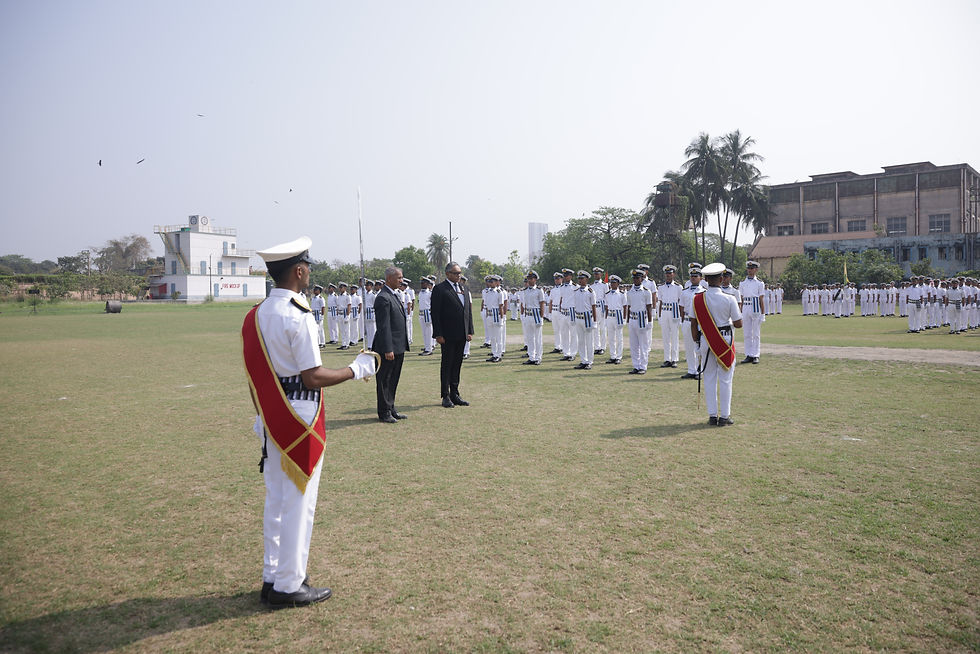
By the time all these elements came together in the final rehearsals, the transformation was visible. What had been disjointed and uncertain was now a single, synchronised body. The grounds, dressed with colourful tents, flags flying from every post, looked the part. The institution looked the part.
The Morning of 13th March
By nine in the morning, the contingents were in position. The Chief Guest, Shri Shyam Jagannathan, IAS, Director General of Shipping, arrived and was received with a guard of honour befitting the occasion. He was joined by the Campus Director, Rear Admiral (Retired) Shri Amit Bose, VSM, and a distinguished gathering that included Shri Ponnada Sriramulu, DGLL; Shri Kuldeep Singh of the Inland Waterways Authority of India; Inspector General Iqbal Singh Chauhan of the Indian Coast Guard; Shri Anandamoy Das of the American Bureau of Shipping; representatives from MMD Kolkata, Bank of Baroda, and the DMET alumni fraternity, and the parents, who had come from across the country for this one morning.
The band struck up. The parade commenced.

The fourth-year cadets led, as was their right. Behind them came the contingents of all ten sadans, Bose, Diesel, Edison, Faraday, Froude, Marconi, Newton, Parsons, Raman, and Rankine, each led by their Senior Cadet Captain, their steps falling together in the kind of unison that only weeks of shared effort can produce. When they came to the salute, arms raised toward the Tiranga, chins up, backs straight, something in the air changed. The moment had weight.
Later, when the seniors marched past the family enclosure, each parent was scanning the white uniforms for one specific face. One officer in that sea of officers who belonged to them. That moment, the searching, and then the finding, is the quiet heart of every passing out parade.

The ceremony closed with the presentation of awards recognising excellence in academics, sports, and overall performance. In his address, Shri Jagannathan spoke of the responsibility the graduates were now stepping into, to serve the maritime sector with technical precision, professional integrity, and the kind of ethical commitment that this institution has always demanded of its people.
The People Nobody Photographs
For all the ceremony, the morning's most human moments happened at its edges.
In the audience, parents who had sent their children here years ago, half-hopeful and quietly worried, sat watching. They had seen them come home on breaks changed in ways that were hard to name. A little learner. A little quieter. Something settled behind the eyes that hadn't been there before. Now here they were: officers. Not just qualified engineers, but people who had been shaped by something that no syllabus can fully account for.

Watching a parent cry at their child's passing out parade is not a sentimental thing. It is a recognition. Every polished boot, every early morning, every gruelling practice session had a person inside it, someone who chose to leave home and become something greater than they were, and did.
Bon Voyage, Sir
When the parade finally broke, when the discipline gave way just for a moment to something warmer and louder, the juniors did what juniors here always do. They yelled it across the ground: Bon Voyage, Sir — to every senior they had watched, learned from, argued with, laughed with. The words bounced off the old buildings of DMET and hung in the morning air.

The grounds of P-19, Taratala Road, have seen many such mornings. Decades of them. Each one a different batch, a different set of faces, the same tradition. And if the Passing Out Parade of The Class of 2026 is any measure, they will see many more, each one a testament to what young people can do when discipline, purpose, and pride are made to march together.
To the Batch of 2022–26: fair winds, and following seas. The whites will fade, the brass will weather, but what was built on this ground — in the drill, the discipline, and the early mornings — sails on
Find Posts On Social Media: LinkedIn: https://www.linkedin.com/posts/imukolkata-dmet-meri-ugcPost-7440457331810734080-UsWB?utm_source=share&utm_medium=member_desktop&rcm=ACoAAEbKUOgBDd7QgcR1ZK8H3RzFtQb8dZGyFmc Instagram: https://www.instagram.com/p/DWE3tNMknDm/?utm_source=ig_web_copy_link&igsh=MzRlODBiNWFlZA== Facebook: https://www.facebook.com/share/p/1XNgESfeom/
Authors: Cadet Avijit Ray - 10462 Cadet Monodeep Saha - 10550 Cadet Aditya Kumar - 10411